
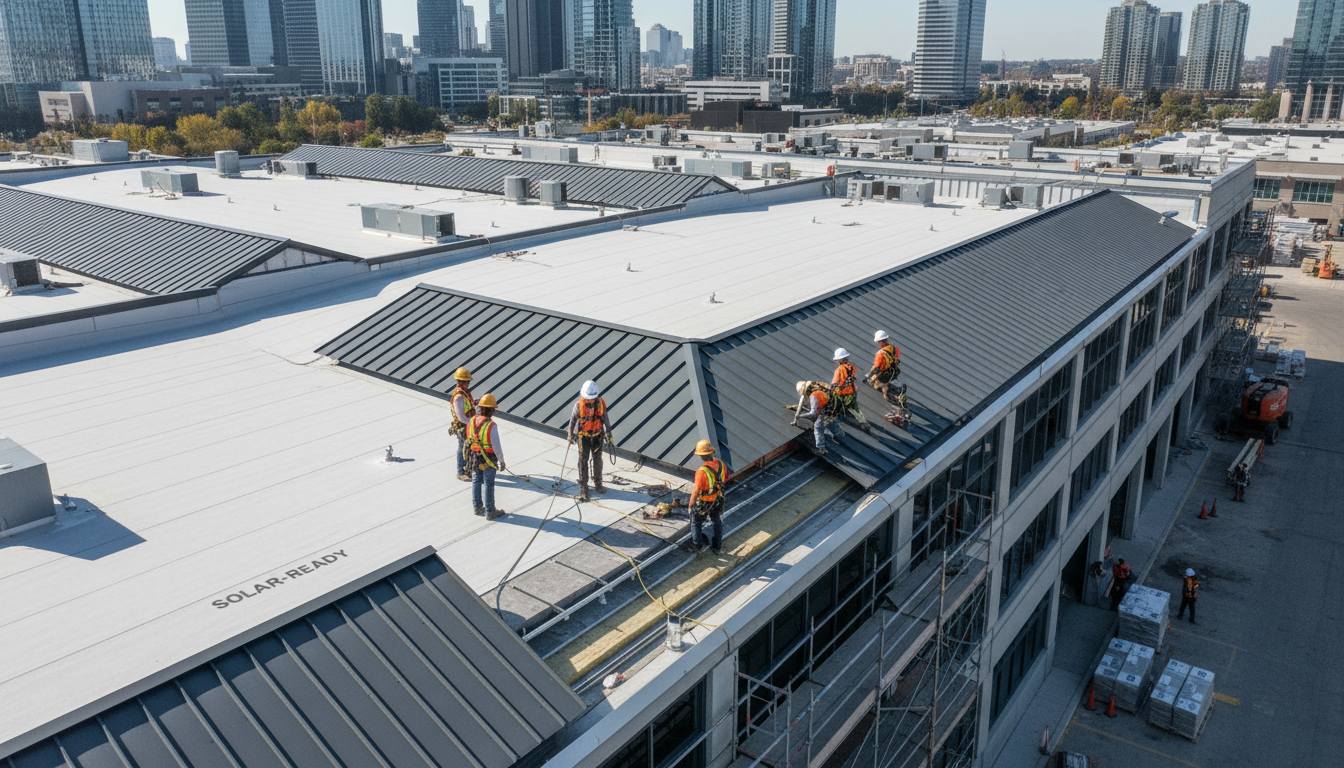
Choosing the right commercial roofing system is one of the most significant investments a building owner or facility manager will ever make. Unlike residential roofs, which are primarily designed for aesthetics and steep water runoff, a commercial roofing system is a complex, engineered assembly designed to protect large-scale assets, manage extreme thermal loads, and provide long-term durability for flat or low-slope structures.
In simple terms, it is the protective “skin” of your business. Depending on your building’s needs, this system might consist of single-ply membranes like TPO or PVC, multi-layered asphalt systems (Built-Up Roofing), or high-performance metal panels. Each system has its own “personality”—some are built to reflect the sun and lower your AC bills, while others are designed to handle heavy foot traffic from HVAC technicians.
Why Your Commercial Roof is More Than Just a “Cover”
When you look at a large warehouse or a retail center, the roof often looks like a simple flat surface. However, beneath that top layer is a sophisticated stack of components working in harmony. A standard commercial roofing system usually includes:
-
The Deck: The structural base (usually steel, concrete, or wood).
-
The Vapor Barrier: Keeps moisture from inside the building from ruining the insulation.
-
Insulation: The “blanket” that keeps your energy bills from skyrocketing.
-
The Membrane: The final waterproof layer that battles the elements.
Choosing the wrong combination can lead to “ponding” water, structural rot, or a roof that “fails” years before its warranty expires.
The Most Popular Types of Commercial Roofing Systems
There is no “one-size-fits-all” in the commercial world. Here is a breakdown of the heavy hitters in the industry today:
1. Single-Ply Membranes (TPO, PVC, and EPDM)
These are currently the most popular choice for modern commercial buildings. They come in large rolls and are either glued, mechanically fastened, or heat-welded together.
-
TPO (Thermoplastic Polyolefin): The “rising star.” It’s naturally reflective (white), which helps reduce cooling costs. It’s great for warehouses and office buildings.
-
PVC (Polyvinyl Chloride): The “tough guy.” PVC is highly resistant to chemicals, grease, and fire. This makes it the gold standard for restaurants or manufacturing plants.
-
EPDM (Ethylene Propylene Diene Monomer): The “rubber roof.” It’s a durable black synthetic rubber. It’s fantastic for colder climates because it absorbs heat, but it doesn’t quite match TPO in energy efficiency for hot summers.
2. Built-Up Roofing (BUR)
Often called “tar and gravel” roofs, BUR has been around for over 100 years. It consists of multiple layers of bitumen (asphalt) and reinforcing fabrics.
-
Best for: Buildings with heavy foot traffic.
-
Pro Tip: Because it has multiple layers, if the top layer is punctured, you still have several “backup” layers protecting your interior.
3. Metal Roofing
Metal isn’t just for barns anymore. Standing seam metal roofs are becoming the “premium” choice for schools, high-end retail, and government buildings.
-
Longevity: A well-installed metal roof can easily last 50+ years.
-
Sustainability: Most metal roofing is made from recycled materials and is 100% recyclable at the end of its life.
Comparing the Systems at a Glance
| Roofing System | Typical Lifespan | Main Benefit | Best For |
| TPO | 20–25 Years | Energy Efficiency | Modern Warehouses |
| PVC | 20–30 Years | Chemical Resistance | Restaurants / Factories |
| EPDM | 25–30 Years | Cost-Effective | Large, Simple Structures |
| Metal | 40–70 Years | Extreme Longevity | High-Value Assets |
| BUR | 20–30 Years | Heavy-Duty Durability | High-Traffic Roofs |
How to Choose the Right System for Your Building
If you’re feeling overwhelmed by the options, don’t worry—most building owners are. To narrow it down, ask yourself these four questions:
1. What is the building used for?
If you run a commercial kitchen, the oils and grease vented onto the roof will eat through a TPO roof in months. You’d need PVC. If you have heavy HVAC units that require monthly maintenance, a delicate single-ply membrane might get punctured; a thick Built-Up Roof or a Metal roof with walk-pads would be smarter.
2. What is your local climate?
In 2026, we are seeing more extreme weather shifts than ever. If you’re in a “hail alley,” you want a system with high impact resistance (like Modified Bitumen). If you’re in the sun-drenched South, a white reflective TPO roof could save you 30% on your summer cooling costs.
3. How long do you plan to own the building?
If you’re planning to sell the property in 5 years, a budget-friendly EPDM roof might make sense. However, if this is a “legacy” building you plan to keep for 30 years, the higher upfront cost of a Metal roof pays for itself because you won’t have to replace it twice.
Maintenance: The Secret to a 30-Year Roof
The biggest mistake building owners make is the “set it and forget it” mentality. Even the most expensive commercial roofing system will fail if the drains get clogged with leaves or the seams aren’t checked after a windstorm.
The 2-1 Rule:
-
2 Inspections per year: Once in the Spring (to check for winter ice damage) and once in the Fall (to clear debris before the snow hits).
-
1 Inspection after a major storm: High winds can lift the edges of your roof (wind uplift), creating “pockets” where water can hide and rot your deck.
Expert Insight: For every $1 you spend on preventative maintenance, you typically save $4 to $11 in emergency repair costs later. It is the best ROI you can get on your facility budget.
Final Thoughts
Investing in a commercial roofing system isn’t just about stopping leaks; it’s about protecting your employees, your inventory, and your bottom line. Whether you choose the modern efficiency of TPO or the time-tested strength of a metal system, the key is quality installation and consistent care.